
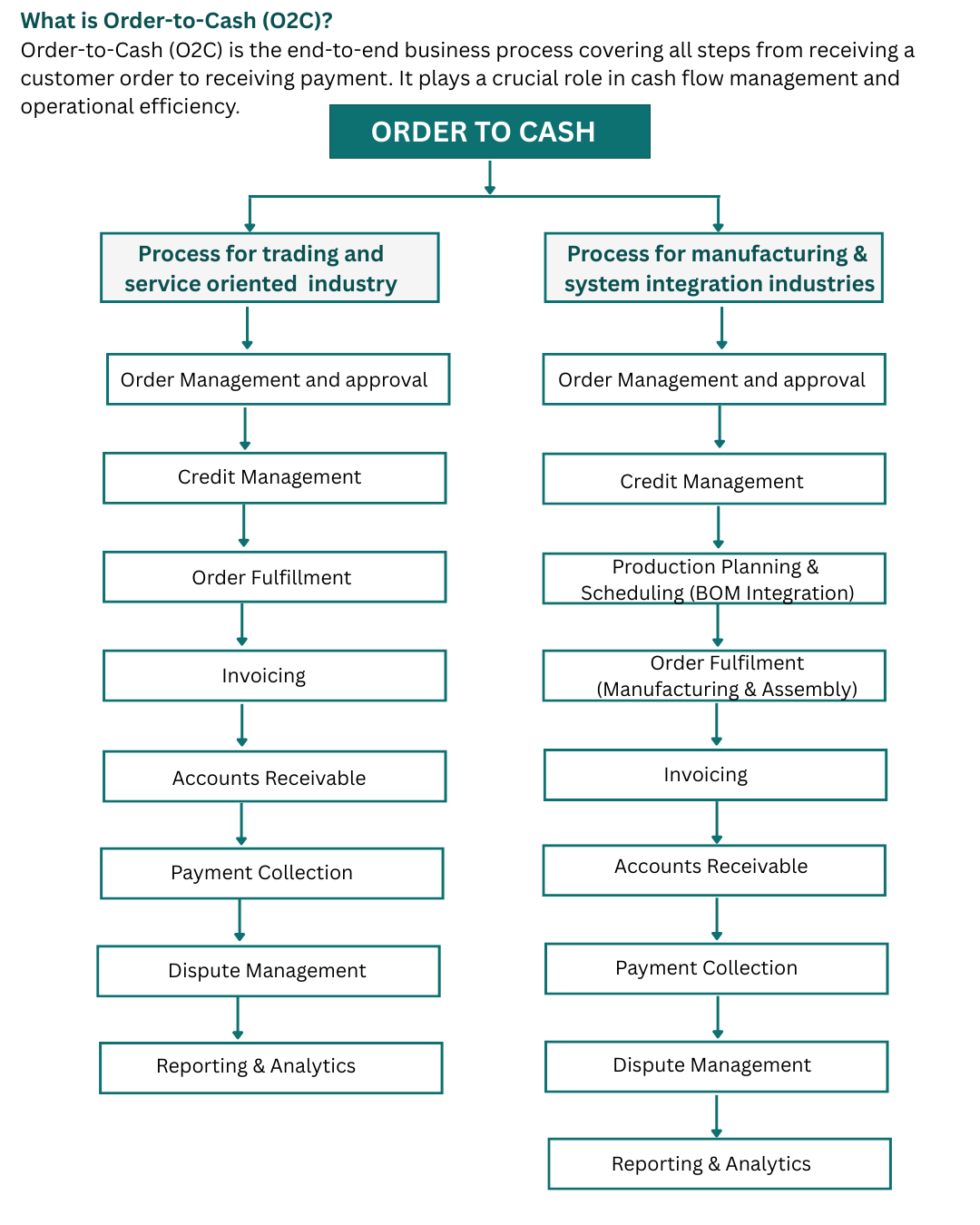
Order-to-Cash (O2C) is the end-to-end business process covering all steps from receiving a customer order to receiving payment. It plays a crucial role in cash flow management and operational efficiency.
Processes of O2C
The O2C process varies across different types of organizations and industries. The industries can be broadly classified as two categories:
1. Service and Pure Trading industry
Example:
Banking and Finance
Health Care and Education Consulting and legal services
2. Manufacturing or integration industries
Example:
Discrete or Process Manufacturing Companies
Engineering, procurement and construction
System Integration and Solution Providers
In the Service and Pure Trading industry, the Bill of Materials (BOM) concept is not required. However, in manufacturing or system integration industries, BOM or Recipe Management plays a vital role. The process can be BOM-oriented or non-BOM-oriented, depending on the industry category.
For industries involving manufacturing or system integration, BOM plays a crucial role in ensuring order feasibility before proceeding with production. It helps determine material requirements, assess stock availability, and ensure cost-effectiveness before committing to an order.
Steps in the Order-to-Cash (O2C) Process
| Service and Trading industry | Manufacturing or integration industries | |
| 1 | Order Management and approval. | Order Management and approval. |
| 2 | Credit Management | Credit Management |
| 3 | Order Fulfilment | Production Planning & Scheduling (BOM Integration) |
| 4 | Invoicing | Order Fulfilment (Manufacturing & Assembly) |
| 5 | Accounts Receivable | Invoicing |
| 6 | Payment Collection | Accounts Receivable |
| 7 | Dispute Management | Payment Collection |
| 8 | Reporting & Analytics | Dispute Management |
| 9 | Reporting & Analytics | |
Insight of each step of processes
1. Order Management
Orders can range from simple stockable products to complex multi-location, multi-stage, and multi-schedule deliveries. Billing schedules may vary—based on delivery, periodic intervals, consumption, or multiple payment milestones.
In the case of Manufacturing and Integration industries, BOM plays a vital role to arrive the cost and technical viability, and delivery commitment. BOM is referenced to check the required raw materials and components.
When an order is logged with all check points, then rest of the processes will be more automatically happens without any errors or reworks.
Normally, the complex oriented order is governed by the Order Check list with multilevel of work flow process. The order management goes for approval work flow processes to validate the order and accept with various check lists by the organisation.
On approval of the order, an automatic order acceptance will be communicated to customer.
Credit Management
Credit management is important criteria of the work flow. Order is being evaluated in multiple dimensions of the stake holders. Normally, by three different views namely, Marketing Approval: Validates the viability of the order and the strategic of the future business.
Technical Approval: Validates the order fulfilment technical viability.
Finance Approval: This is finance approval, carefully analysis on the credit worthiness of the customer, financial viability and costing, previous experience etc.
Production Planning & Scheduling (BOM Integration)[applicable for Manufacturing and Integration industries]
If the product requires manufacturing, the BOM is used to:
- Identify required raw materials and sub-components.
- Check stock levels.
- Trigger Material Requirement Planning (MRP) if needed.
- Schedule production based on available capacity.
Order Fulfillment (Manufacturing & Assembly)
- The production process is executed based on the BOM.
- Routing and machine scheduling are done for manufacturing.
- Final products are assembled and quality-checked before dispatch.
- Picking, packing, and shipping products/services
Invoicing
Once the order is shipped, an invoice is generated automatically, based on the criteria defined in the order. Shipment happens fully or multiple stages, the invoice has to be generated based on the order criteria, whether it is in advance, prorate basis of delivery, periodic basis, consumption basis.
Accounts Receivable & Payment Collection
Payments are tracked, and reminders are sent if required. Advance payment to be apportion based on the payment terms in the order. Aging analysis, follow-up remainders, interest or penal charges for delay payment and discount for advance payment option etc. based on the policy of the organisation.
Dispute Management
Dispute Management plays a crucial role in resolving discrepancies related to order fulfillment, invoicing, or product quality. Effective dispute handling minimizes revenue losses, maintains customer relationships, and ensures compliance with contractual agreements
Common Dispute Areas:
- Order mismatches (wrong items, incorrect quantities, or delivery delays).
- Invoice disputes (incorrect pricing, tax errors, or misapplied discounts).
- Quality concerns (damaged goods, non-compliance with specifications).
- Payment delays and liquidated damages.
Resolution Strategies:
- Establish clear communication channels between sales, finance, and customers.
- Implement an automated dispute resolution workflow to track claims and actions.
- Apply penalties (liquidated damages) based on contractual terms for late payments or non-fulfillment.
- As a last resort, consider blacklisting or blocking further production and deliveries until the dispute is resolved amicably
Reporting & Analytics
Finally the reporting and analytics on multiple dimension
- Tracking order completion time, production efficiency, and cash flow.
- AI-based forecasting for demand and stock replenishment.
- Monitoring performance and optimizing the O2C cycle
How Sky-ERP helps?
Traditional O2C processes often lead to inefficiencies, delayed payments, and errors in production planning. SKY-ERP ensures end-to-end automation and real-time insights, preventing over-trading and optimizing order fulfilment.
Especially SKY-ERP helps businesses to handles complex order management with best industry practices being adopted by leveraging automation and advanced analytics to streamline operations and not getting into the trap of over trading, as every information is instantaneous helps to take right decision making at right time.
Benefits for well-defined O2C
- Automated order processing for faster fulfillment.
- Proactive risk detection with automated alerts and escalation workflows.
- Supports for any type of industries.
- Integrated credit checks to minimize financial risk.
- Seamless invoicing and payment tracking with reminders.
- AI-driven analytics for real-time insights on receivables and cash flow.


